What you will take away
- Start with the business model, not the machine alone.
- The best early plan has one target venue type, one launch budget, and one service rhythm.
- The first 30 days should feel like a small operating plan, not a scramble after delivery.
Ready for machine fit help?
Use what you learned here, then bring your venue, budget, and timeline into the purchase-path conversation.
Before you buy, picture the first Tuesday
The most useful way to plan a vending business is to imagine an ordinary operating day, not the launch announcement. The machine is already placed. The first rush has passed. Someone needs to check supplies, wipe the area, confirm payments, answer the venue manager, and decide whether the machine is earning the right spot.
That is where good operators separate themselves. They do not only ask, 'Can this machine make cotton candy?' They ask, 'Who owns the refill routine, what happens when a venue calls, where do supplies live, and how will I know this location is working?'
Bloomjoy sells equipment, but we also operate machines. That changes how we think about the purchase. A machine is exciting. A repeatable operating rhythm is what gives it a real chance to become a business.
What we would tell a first-time operator
Do not start with ten possible ideas. Start with one target customer, one venue type, one machine fit, and one weekly routine you can actually keep.
Start with the business model
A cotton candy machine can be a vending placement, an event attraction, a catering add-on, or a test of a larger venue strategy. The machine is the fun part. The business is the repeatable system around it.
For most new operators, the simplest first question is: do you want a machine that earns from a fixed location, or do you want a portable offer that you bring to events? Those are both good businesses, but they ask different things from you.
A fixed-location operator spends more time on site selection, owner relationships, uptime, restock, and reporting. An event operator spends more time on booking, transport, setup, line flow, staffing, and cleanup. If you pick the wrong model, the machine can still be good, but the work around it will feel wrong.
Use this to avoid buying for the wrong job.
| Path | Best machine fit | What you need to prove |
|---|---|---|
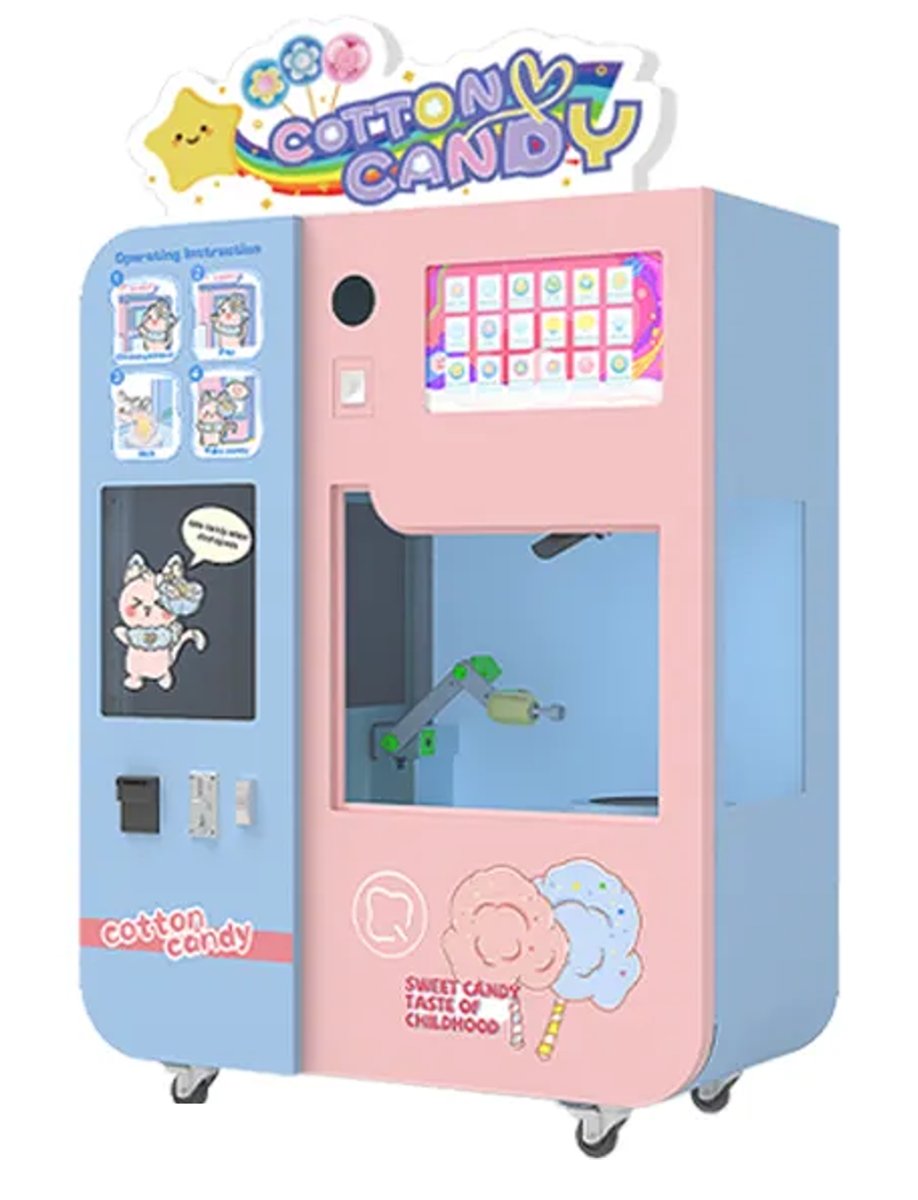
| Fixed-location vending | Commercial Machine | Foot traffic, power access, venue agreement, service schedule |
| Events and pop-ups | Mini Machine | Booking demand, staffing flow, transport plan, event pricing |
| Low-volume testing | Micro Machine | Basic-shape demand, simple operation, smaller budget fit |
Build the first 30-day launch plan
Do not wait until the machine arrives to figure out where it goes, who checks it, how supplies are ordered, or what happens when something needs support. A calm launch is planned before the crate shows up.
The right v1 plan is not fancy. It is a short operating routine you can actually follow. A buyer who knows the first venue, the first supply order, the service owner, and the support path is in a much better position than a buyer who only knows the machine model.
- 1
Week 1: pick your target venue
Choose one primary venue type, like family entertainment centers, tourist retail, malls, arcades, skating rinks, or event venues.
- 2
Week 2: price the full launch
Estimate machine, shipping, opening supplies, insurance, customer payment setup, permits, signage, and a maintenance reserve.
- 3
Week 3: secure the first site or booking lane
Start outreach with a simple pitch, photos, the service plan, and the reason the machine helps the venue.
- 4
Week 4: prepare the operating rhythm
Write the refill, cleaning, check-in, and issue-escalation routine before your first customer order.
- 5
Delivery week: slow down on purpose
Confirm access, placement, power, supplies, and who is present before the machine shows up. A rushed delivery creates avoidable stress.
- 6
First week live: inspect more often than you think
Check customer flow, cleanliness, supply use, and venue feedback closely. The first week teaches you what the spreadsheet missed.
Write the weekly operator rhythm
A small vending business becomes easier when the week has a pattern. You do not need a corporate operations manual, but you do need a rhythm that tells you what happens every week, who does it, and what proof you look at.
For a single machine, that rhythm may be simple. For multiple machines, it becomes the difference between feeling organized and feeling like every text is an emergency.
A starter rhythm you can adapt before launch.
| Operator moment | What to check | Why it matters |
|---|---|---|
| Start of week | Supply levels, upcoming venue hours, service schedule | Prevents avoidable stockouts and missed access windows |
| Service visit | Cleanliness, sugar/stick levels, payment flow, visible placement | Keeps the machine guest-ready and venue-friendly |
| Venue check-in | Staff feedback, guest questions, placement concerns, upcoming events | Turns the venue into a partner instead of a landlord |
| End of week | Sales trend, issues, supply use, next restock order | Helps you decide whether to adjust placement, pitch, or routine |
Avoid the first-launch mistakes we see most often
New operators usually do not fail because they forgot to be excited. They struggle because they skipped the boring pieces that make the exciting part repeatable.
Use this as a pre-launch honesty check. If any item makes you pause, that is not a bad sign. It is exactly the kind of gap you want to find before money, freight, and venue expectations are involved.
Operator checklist
- Buying before choosing the first business model
- Assuming the busiest location is automatically the best location
- Planning supplies only for opening day instead of the first operating cycle
- Leaving venue communication vague until there is a problem
- Forgetting that delivery, access, power, and cleaning are part of the business
- Treating legal, tax, insurance, and permit research as something to solve later
Choose support before you need support
A vending business is easier to run when support boundaries are clear. Technical troubleshooting belongs with manufacturer first-line support. Bloomjoy Plus adds onboarding, playbooks, operator guidance, and concierge help during business hours.
That split matters because it keeps your plan honest. You are not buying a magic box. You are building a small operating system around a very eye-catching machine.
Operator rule of thumb
If a task affects machine uptime, write down who owns it before launch: venue staff, your team, manufacturer support, or Bloomjoy concierge.
Operator checklist
- Machine placement and power confirmed
- Opening sugar and sticks ordered
- Payment setup planned
- Cleaning and refill owner assigned
- WeChat/manufacturer support path understood
- Local permits, insurance, and business registration researched
Use official startup guidance for the admin layer
Bloomjoy can help you think through machine fit and operations, but business registration, tax, insurance, and permits vary by location. Treat those as a real part of launch, not a paperwork chore for later.
The SBA recommends thinking through market research, business planning, funding, location, structure, tax IDs, licenses, permits, and banking as part of starting a business. Use that as your admin checklist, then layer your machine plan on top.
- Decide whether the business will be a solo venture, partnership, LLC, or another structure.
- Research state and local registration requirements before applying for an EIN.
- Open a business bank account once your registration paperwork is ready.
- Ask a local professional about tax, insurance, and permit requirements for your state and venue type.